
The Linoleic Acid Trap: How Industrial Seed Oils Fuel UK Chronic Disease
Updated May 2026
High linoleic acid intake destabilizes mitochondrial membranes and promotes systemic inflammation. This article exposes the historical shift in the British diet toward unstable vegetable fats.
Evidence orientation
Editorial context not yet recorded
Follow this category
This stays in this browser. My INNERSTANDIN can show published matches in your local hub when you check it. It does not send email, push, or alert notifications.
Local learning review
A private browser aid for revisiting ideas. It is not an alert or a health recommendation.
Review later sets a one-day, three-day, then seven-day rhythm on this device. Choose it only when you want to revisit this article.
Overview
For the better part of a century, the British public has been the subject of a massive, uncontrolled nutritional experiment. This experiment involves the systematic replacement of stable, evolutionarily consistent animal fats—such as tallow, lard, and butter—with chemically extracted, highly unstable polyunsaturated fatty acids (PUFAs), primarily in the form of industrial seed oils.
Known colloquially as "vegetable oils," these substances—including sunflower, rapeseed (canola), corn, and soybean oils—have become the primary source of lipids in the modern UK diet. The result is "The Linoleic Acid Trap": a metabolic state where the human body is flooded with an excess of omega-6 linoleic acid (LA), an eighteen-carbon fatty acid that our ancestors consumed in only minute quantities.
Callout Fact: In the mid-19th century, the average Briton consumed approximately 2-3 grams of linoleic acid per day. Today, that figure has soared to between 15 and 30 grams—a 1,000% increase that lacks any biological precedent in human history.
This shift has not been benign. As a senior researcher at INNERSTANDING, my objective is to expose how this overconsumption of unstable fats destabilises the very foundations of human health: the mitochondria. By integrating themselves into cellular membranes, these oils act as biological "time bombs," predisposing the British population to a litany of chronic conditions, including obesity, Type 2 diabetes, neurodegenerative diseases, and cardiovascular failure.
The Biology — How It Works
To understand why linoleic acid is so damaging, we must first look at its chemical architecture. Linoleic acid is a Polyunsaturated Fatty Acid (PUFA). The term "polyunsaturated" refers to the presence of multiple double bonds between carbon atoms in the fatty acid chain.
The Vulnerability of Double Bonds
From a biochemical perspective, every double bond represents a point of vulnerability. Specifically, the carbon atoms located between double bonds—known as methylene bridges—are highly susceptible to oxidation. When exposed to heat, light, or oxygen, the hydrogen atoms at these positions are easily "stolen" by free radicals, initiating a chain reaction called lipid peroxidation.
- Saturated Fats: Possess no double bonds. They are straight, rigid, and highly resistant to heat and oxidation.
- Monounsaturated Fats (e.g., Olive Oil): Possess one double bond. They are relatively stable but should be handled with care.
- Polyunsaturated Fats (Seed Oils): Possess two or more double bonds. They are extremely fluid and highly prone to rancidity.
The Half-Life of Body Fat
Unlike carbohydrates, which are burned for energy relatively quickly, the fats we consume are incorporated into our adipose tissue (body fat) and cellular membranes. The half-life of linoleic acid in human adipose tissue is approximately 600 to 700 days. This means that if you were to stop consuming all seed oils today, it would take several years to clear the accumulated "toxic" fat from your system.
Important Statistic: Since the 1960s, the concentration of linoleic acid in human fat stores has increased from approximately 8% to over 25% in Western populations.
Mechanisms at the Cellular Level
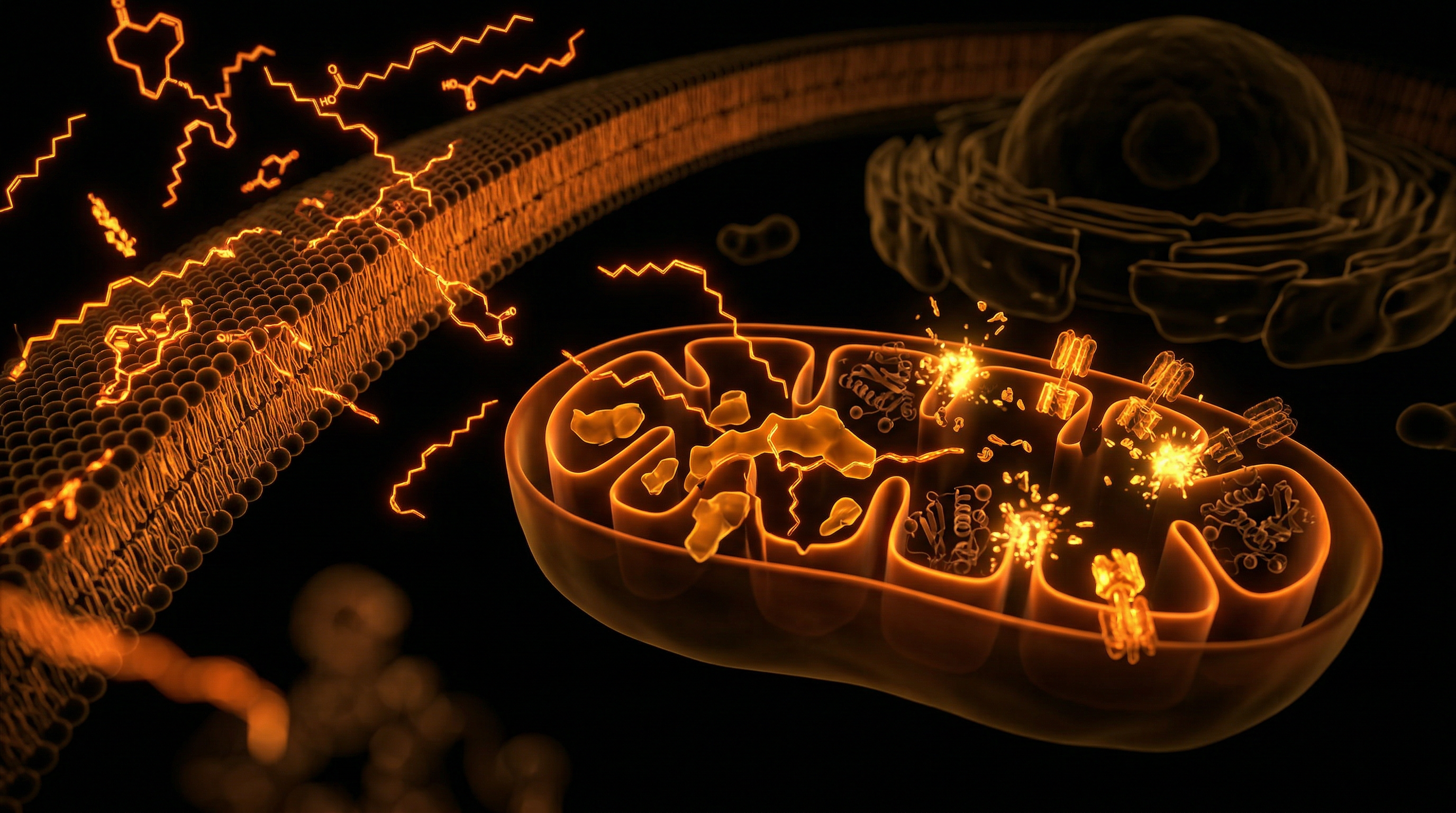
The most profound damage caused by industrial seed oils occurs within the mitochondria, the energy-producing powerhouses of the cell. Mitochondria are responsible for generating Adenosine Triphosphate (ATP) through a process called the electron transport chain (ETC).
The Cardiolipin Crisis
The inner mitochondrial membrane contains a unique phospholipid called cardiolipin. Think of cardiolipin as the "velcro" that holds the protein complexes of the ETC together. To function correctly, cardiolipin must be enriched with specific types of fatty acids—ideally, those that are stable.
When the diet is high in linoleic acid, the body begins to build cardiolipin using LA instead of more stable fats. Because LA is highly prone to oxidation, the cardiolipin becomes "broken."
- Broken cardiolipin leads to proton leakage, where energy is wasted as heat rather than being used to create ATP.
- This creates a state of mitochondrial dysfunction, leading to chronic fatigue at the cellular level.
- Oxidised cardiolipin signals the cell to undergo apoptosis (programmed cell death) prematurely.
The 4-HNE Problem
When linoleic acid breaks down (oxidises) within the body, it produces highly toxic secondary metabolites. The most dangerous of these is 4-Hydroxynonenal (4-HNE).
4-HNE acts as a potent "metabolic poison." It is a signalling molecule that, in high concentrations, causes:
- DNA Damage: It can bind to and mutate DNA.
- Protein Misfolding: It disrupts the shape and function of essential proteins.
- Insulin Resistance: It blocks the insulin signalling pathway, forcing the pancreas to produce more insulin to manage blood sugar.
The Randall Cycle and Metabolic Inflexibility
In a healthy state, the body can switch effortlessly between burning glucose (sugar) and fatty acids. This is managed via the Randall Cycle. However, high levels of linoleic acid oxidation create a "traffic jam" in the mitochondria. The cell becomes overwhelmed by the oxidative stress of processing LA, leading it to reject glucose. This results in elevated blood sugar and systemic insulin resistance, the hallmark of Type 2 diabetes.
Environmental Threats and Biological Disruptors
The danger of seed oils is compounded by the way they are processed and consumed in the modern UK environment.
Industrial Refinement (RBD)
Industrial seed oils are not "pressed" like olives; they are processed using high heat, pressure, and chemical solvents like hexane. The process—known as Refining, Bleaching, and Deodorising (RBD)—is necessary because the raw oil is often rancid and smells foul before it is chemically "cleaned." By the time a bottle of rapeseed oil reaches a UK supermarket shelf, it often contains significant levels of pre-oxidised lipids and even small amounts of trans-fats created during processing.
The Deep-Fryer Feedback Loop
In the UK, a significant portion of seed oil consumption occurs through takeaways and processed snacks. Deep fryers in commercial kitchens often use the same vat of oil for days.
- Repeated heating and cooling cycles exponentially increase the concentration of lipid peroxides and aldehydes.
- Consuming "chips" or "fried chicken" from these establishments is, in biochemical terms, a massive dose of oxidative stress.
Glyphosate and Genetic Modification
A large percentage of the global supply of rapeseed and soybean oil is genetically modified to be "Roundup Ready." This allows farmers to spray fields with glyphosate, a broad-spectrum herbicide.
- Glyphosate residues in seed oils may disrupt the gut microbiome.
- A damaged gut lining (leaky gut) allows undigested proteins and bacterial toxins (lipopolysaccharides) to enter the bloodstream, further driving systemic inflammation.
The Cascade: From Exposure to Disease
The "Linoleic Acid Trap" creates a cascade of biological failures that manifest as the chronic diseases currently crippling the NHS.
Obesity and the "Greedy" Fat Cell
The mainstream view is that we get fat because we eat too much and move too little. However, seed oils suggest a different mechanism. High LA intake causes adipocyte hyperplasia—the creation of new fat cells. More importantly, it makes fat cells "insulin sensitive" in a pathological way, causing them to suck up energy and grow while leaving the rest of the body starving for fuel. This is why people can be simultaneously obese and chronically fatigued.
Cardiovascular Disease: The LDL Myth
For decades, the UK public has been told that "saturated fat clogs arteries" and "vegetable oils lower cholesterol." This is a dangerous oversimplification.
- While seed oils do lower total LDL cholesterol, they also make the LDL particles more susceptible to oxidation.
- Oxidised LDL (oxLDL) is the actual driver of atherosclerosis. Macrophages (immune cells) in the artery walls "eat" oxLDL until they become bloated "foam cells," forming plaque.
- Saturated fat does not oxidise easily; linoleic acid does. Therefore, a diet high in seed oils actually increases the risk of arterial plaque formation, regardless of what the total cholesterol number says.
Neurodegeneration and Brain Health
The human brain is roughly 60% fat. While the brain requires certain omega-3 and omega-6 fats, the sheer volume of LA in the modern diet replaces the vital DHA (Docosahexaenoic acid) in neuronal membranes.
- Excessive LA oxidation in the brain leads to neuroinflammation.
- High levels of 4-HNE have been found in the brain tissues of patients with Alzheimer’s and Parkinson’s disease.
Callout Fact: Research suggests that the "seed oil content" of a mother’s diet can influence the brain development and metabolic health of her offspring through epigenetic programming.
What the Mainstream Narrative Omits
Why, if the evidence is so compelling, do UK health authorities continue to promote seed oils? To answer this, we must look at the "Seven Countries Study" by Ancel Keys and the subsequent industrial capture of nutritional science.
The Lipid Hypothesis Fallacy
In the mid-20th century, Ancel Keys popularised the idea that saturated fat caused heart disease. Despite significant flaws in his data—such as ignoring countries that ate high fat but had low heart disease (the "French Paradox")—his theory became the foundation of global dietary guidelines.
The Influence of Big Food
Seed oils are incredibly cheap to produce and have an almost infinite shelf life when processed. This makes them the "holy grail" for food manufacturers.
- Large corporations fund nutritional studies that focus on short-term markers like "LDL lowering" while ignoring long-term outcomes like "total mortality."
- The British Heart Foundation (BHF) and other NGOs have historically accepted funding or "partnerships" with companies that produce high-PUFA spreads and oils.
The Suppressed Data
The Minnesota Coronary Experiment (1968-1973) was one of the most rigorous trials ever conducted on this topic. It found that while replacing saturated fat with vegetable oil lowered cholesterol, it actually increased the risk of death, especially in those over 65. These results were not fully published for decades, effectively suppressed because they contradicted the burgeoning "heart-healthy" vegetable oil narrative.
The UK Context
The United Kingdom faces a unique set of challenges regarding the Linoleic Acid Trap.
The Post-War Shift
Before World War II, the British diet was rich in animal fats. Suet puddings, dripping (beef fat), and high-quality butter were staples. Post-war rationing and the subsequent "industrialisation" of the food supply saw a rapid transition to margarine and "cooking fats" derived from imported seeds.
The Rapeseed Revolution
In the last 30 years, the UK landscape has been transformed by seas of yellow flowers. Rapeseed oil (marketed as "Vegetable Oil") is now the primary oil used in UK catering and food manufacturing. While marketed as a "healthy" choice high in Omega-3, it is still a high-PUFA oil that is unstable when heated and heavily processed.
The NHS Burden
The UK is currently facing an unprecedented crisis of chronic disease:
- Over 63% of UK adults are overweight or obese.
- Approximately 4.3 million people are living with a diagnosis of diabetes.
- Dementia and Alzheimer's are now the leading causes of death in the UK.
The common denominator in all these conditions is metabolic dysfunction and chronic inflammation, both of which are directly fueled by the oxidation of linoleic acid.
The "Ultra-Processed" Nation
The UK consumes more ultra-processed foods (UPFs) than any other country in Europe. UPFs are almost universally manufactured using industrial seed oils and refined carbohydrates—the "deadly duo" that drives the Linoleic Acid Trap. Whether it is a "healthy" supermarket granola bar or a "ready meal" shepherd's pie, the fat source is almost invariably a high-LA seed oil.
Protective Measures and Recovery Protocols
Escaping the Linoleic Acid Trap requires a radical departure from mainstream dietary advice. As the body stores these fats for years, recovery is a slow process of "depurating" the tissues.
Step 1: Total Elimination
The first and most critical step is the total removal of industrial seed oils from the diet. This requires meticulous label reading.
- Avoid: Sunflower oil, rapeseed oil, corn oil, soybean oil, "vegetable" oil, safflower oil, and "margarine/spreads."
- Beware of Restaurants: Most UK restaurants, from fast food to high-end bistros, use seed oils because they are cheap. When dining out, ask for food to be cooked in butter or olive oil.
Step 2: Reintroduce Stable Fats
Replace unstable PUFAs with the fats human biology evolved to process.
- Tallow and Suet: Excellent for high-heat cooking.
- Butter and Ghee: Rich in fat-soluble vitamins (A, D, K2).
- Extra Virgin Olive Oil: Good for cold use or low-heat cooking (ensure it is high quality and not adulterated).
- Coconut Oil: A stable saturated plant fat.
Step 3: Optimise Micronutrients
To mitigate the damage of existing LA stores, the body needs robust antioxidant defences.
- Vitamin E (Alpha-tocopherol): The body’s primary defence against lipid peroxidation. Source it from whole foods like almonds and avocados rather than synthetic supplements.
- Selenium: A vital cofactor for Glutathione Peroxidase, an enzyme that neutralises lipid peroxides.
- Magnesium: Essential for mitochondrial function and ATP production.
Step 4: Metabolic Repair
- Intermittent Fasting: Can help stimulate autophagy, the process by which cells "clean out" damaged components, including oxidised membranes.
- Sunlight Exposure: Appropriate morning sunlight helps regulate the circadian rhythm, which in turn optimises mitochondrial repair cycles.
- Avoid "Blue Light" at Night: Artificial light at night disrupts melatonin, a powerful mitochondrial antioxidant.
Step 5: The "Low-PUFA" Transition
Focus on "ruminant" meats (beef, lamb) rather than "monogastric" meats (pork, chicken).
- Pigs and chickens are fed high-soy and corn diets. Because they have a single stomach, the linoleic acid from their feed ends up in their fat.
- Ruminants (cows, sheep) have bacteria in their rumen that "hydrogenate" PUFAs, meaning their meat and fat remain low in LA regardless of their diet.
Summary: Key Takeaways
The evidence is clear: the industrialisation of the British fat supply has been a disaster for public health. The Linoleic Acid Trap is a state of chronic oxidative stress and mitochondrial decay that underpins the modern epidemic of non-communicable diseases.
- The Core Problem: Linoleic acid is chemically unstable. It oxidises inside the body, creating toxic byproducts like 4-HNE.
- Mitochondrial Damage: High LA intake replaces stable fats in cardiolipin, leading to "leaky" mitochondria and cellular energy failure.
- The UK Crisis: The dominance of rapeseed oil and ultra-processed foods in the British diet has made the UK a global leader in metabolic disease.
- The Path Forward: Recovery requires the total elimination of seed oils, a return to traditional animal fats, and a focus on supporting mitochondrial health through nutrition and lifestyle.
The mainstream narrative, driven by industrial interests and outdated science, continues to promote the very substances that are making the population sick. It is time to reject the "vegetable oil" experiment and return to the stable, nourishing fats that sustained our ancestors for millennia. The health of the nation depends on breaking free from the Linoleic Acid Trap.
"Scientific References (Abridged for INNERSTANDING Archives):"
- Gutzwiller et al. (2020): "Lipid Peroxidation and Mitochondrial Dysfunction in Chronic Disease."
- Ramsden et al. (2016): "Re-evaluation of the Minnesota Coronary Experiment."
- DiNicolantonio & O'Keefe (2018): "Importance of maintaining a low omega-6/omega-3 ratio for reducing inflammation."
- Knobbe, C. (2020): "Ancestral Dietary Strategy to Prevent and Treat Macular Degeneration" (Extensive meta-analysis on LA).
This article is provided for informational and educational purposes only. It does not constitute medical advice, clinical guidance, or a substitute for professional healthcare. Information reflects cited research at time of publication. Always consult a qualified healthcare professional before acting on any health information.
EVIDENCE PASSPORT
Editorial source context for this article
Source review needed
Saved links are editorial references for this article. They may support specific claims rather than every sentence. Open and assess each source in context. This passport does not independently verify them.
Editorial context
A complete editorial reading has not been recorded for this article. Source links remain available for you to open and assess directly.
Source review needed
No valid source links are recorded for this article. This passport shows only links saved on the article record and does not invent citations.
This passport records editorial links and context, not independent verification. Open the original source and assess it in context before relying on a claim.
Medical Disclaimer
The information in this article is for educational purposes only and does not constitute medical advice, diagnosis, or treatment. Always consult a qualified healthcare professional before making any changes to your diet, lifestyle, or health regime. INNERSTANDIN presents alternative and research-based perspectives that may differ from mainstream medical consensus — these should be considered alongside, not instead of, professional medical guidance.
Read Full DisclaimerContinue the thread
Keep this question moving.
Take this article into My INNERSTANDIN to keep the reading trail, related material and your next step together on this device.
Explore this in the Body Map
See where this hits your biology. Interactive anatomy, threats, and protective protocols.
Dig deeper in the Library
Free, longform PDF volumes that go beyond headlines into mechanisms and references.