
The Omega-6 Imbalance: Realigning the UK Diet for Longevity
Updated May 2026
The modern shift toward a 20:1 Omega-6 to Omega-3 ratio has created a biological environment ripe for disease. Discover the mechanisms for restoring the ancestral fatty acid balance in a processed food landscape.
Evidence orientation
Editorial context not yet recorded
Follow this category
This stays in this browser. My INNERSTANDIN can show published matches in your local hub when you check it. It does not send email, push, or alert notifications.
Local learning review
A private browser aid for revisiting ideas. It is not an alert or a health recommendation.
Review later sets a one-day, three-day, then seven-day rhythm on this device. Choose it only when you want to revisit this article.
Overview
For the vast majority of human evolutionary history, the lipids that formed our cellular membranes and fuelled our metabolic processes were sourced from a balanced milieu of wild flora and fauna. This ancestral state was characterised by an Omega-6 to Omega-3 ratio of approximately 1:1. Within the span of a mere century—a blink in evolutionary time—the Western diet, and particularly the British diet, has undergone a radical transformation. We have moved from a balanced lipid profile to one dominated by industrial seed oils, resulting in a skewed ratio that frequently exceeds 20:1.
This is not merely a change in dietary preference; it is a fundamental biological disruption. The human body is not a furnace that simply burns fuel; it is a complex biological computer that uses dietary fats as structural components and signalling molecules. When we flood the system with Linoleic Acid (LA)—the primary Omega-6 fatty acid found in oils such as soybean, sunflower, corn, and rapeseed—we rewrite the operating system of our cells.
At INNERSTANDING, we recognise that this "Omega-6 Imbalance" is a silent driver of the modern chronic disease epidemic. From the burgeoning rates of obesity and Type 2 diabetes to the rise of neurodegenerative conditions and autoimmune disorders, the common thread is often found in the lipid composition of the cell membrane. This article explores the biochemical reality of this shift, the mechanisms by which it induces systemic failure, and the urgent necessity of reclaiming our ancestral lipid heritage to achieve true longevity in a processed landscape.
The Biology — How It Works
To understand the gravity of the Omega-6 crisis, one must first grasp the basic biochemistry of Polyunsaturated Fatty Acids (PUFAs). These fats are defined by having two or more double bonds in their carbon chain. This molecular structure makes them liquid at room temperature but also renders them highly susceptible to oxidation.
Essentiality and Competition
Both Omega-6 (Linoleic Acid) and Omega-3 (Alpha-Linolenic Acid) are classified as "essential" because the human body cannot synthesise them de novo. However, "essential" does not mean "healthy in unlimited quantities." Both families of fats compete for the same metabolic machinery—specifically the enzymes Delta-6 Desaturase and Delta-5 Desaturase.
Under normal physiological conditions, these enzymes convert LA into Arachidonic Acid (AA) and ALA into Eicosapentaenoic Acid (EPA) and Docosahexaenoic Acid (DHA).
When the diet is overwhelmed by Omega-6, these enzymes are hijacked. The conversion of the anti-inflammatory Omega-3s is stifled, leading to a state of systemic "Omega-3 starvation" even if some Omega-3s are present. This competition is the first bottleneck in the path to chronic inflammation.
The Eicosanoid Balance
The secondary biological role of these fats is as precursors to eicosanoids—short-lived signalling molecules that regulate inflammation, blood clotting, and vascular tone.
- Omega-6 derivatives (via Arachidonic Acid) generally produce pro-inflammatory, pro-aggregatory, and vasoconstrictive eicosanoids (such as Prostaglandin E2 and Leukotriene B4).
- Omega-3 derivatives produce anti-inflammatory or resolving mediators (such as Resolvins and Protectins).
In a balanced system, these two forces work in harmony—Omega-6 initiates a necessary inflammatory response to injury, and Omega-3 resolves it. In the modern UK diet, the "off switch" has been broken, leaving the body in a state of perpetual, low-grade metabolic inflammation.
Mechanisms at the Cellular Level
The most profound damage occurs at the microscopic level, within the very structures that define life: the mitochondria and the cell membrane.
The Cardiolipin Crisis
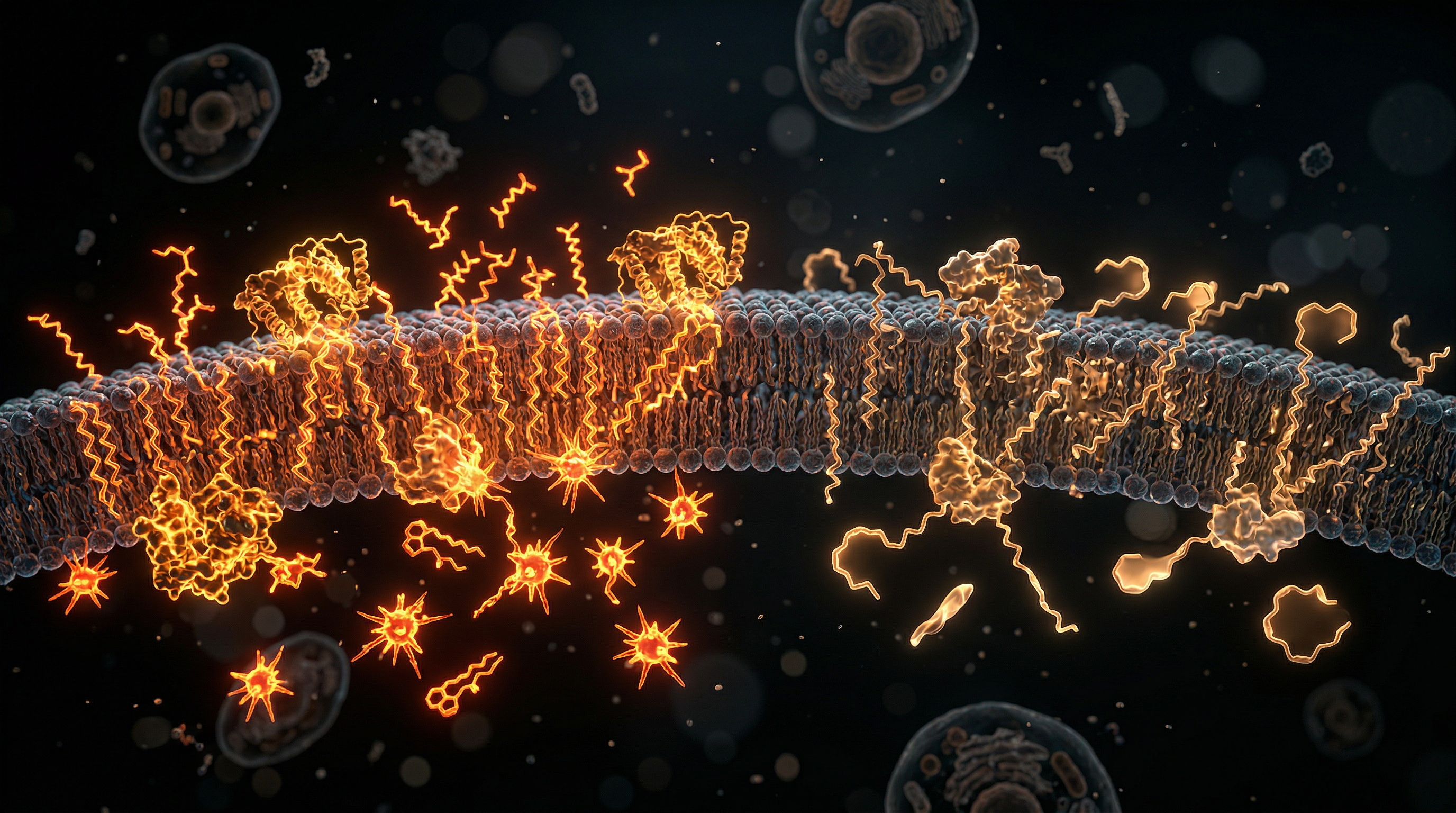
Within the inner mitochondrial membrane lies a unique phospholipid called cardiolipin. Cardiolipin is essential for the function of the Electron Transport Chain (ETC), the process by which we produce ATP (energy). For cardiolipin to function correctly, it must be populated with specific fatty acids, primarily Oleic Acid (from olive oil) or balanced amounts of other fats.
When Linoleic Acid intake is excessive, it integrates into the cardiolipin structure. Because LA contains two double bonds, it is highly prone to lipid peroxidation. When the mitochondria generate Reactive Oxygen Species (ROS) during energy production—a natural byproduct—the LA in the cardiolipin oxidises. This creates a "leaky" membrane, impairing energy production and eventually leading to mitochondrial apoptosis (cell death).
4-HNE: The Toxic Byproduct
When Omega-6 fats oxidise, they don't just "go bad"; they transform into highly reactive aldehydes. The most notorious is 4-Hydroxynonenal (4-HNE).
- 4-HNE acts as a powerful mutagen and signalling disruptor.
- It binds to proteins and DNA, causing structural damage.
- It inhibits the Nrf2 pathway, the body's primary antioxidant defence mechanism.
Studies have shown that 4-HNE levels are significantly elevated in the tissues of patients with Alzheimer's disease, atherosclerosis, and cancer, suggesting that Omega-6 oxidation is a primary driver of these pathologies.
Membrane Fluidity and Signalling
The lipid bilayer of every cell in the body is composed of the fats we ingest. High concentrations of PUFAs increase membrane fluidity beyond optimal levels, making cells more vulnerable to external stressors and disrupting the function of embedded receptors, such as the insulin receptor. This provides a direct biochemical link between seed oil consumption and insulin resistance.
Environmental Threats and Biological Disruptors
The modern environment is a minefield of "hidden" Omega-6. It is no longer a matter of simply avoiding the "vegetable oil" bottle in the kitchen cupboard; the threat is systemic and industrial.
The Rise of the Industrial Seed Oil
The term "vegetable oil" is a marketing masterstroke. In reality, these are industrial seed oils—byproducts of the late 19th-century industrial revolution. Oils like soybean, corn, sunflower, and rapeseed (Canola) require intensive chemical processing, including:
- Hexane Extraction: A solvent used to pull oil from the seeds.
- Degumming: Removing phospholipids that would make the oil cloudy.
- Bleaching: Removing natural pigments.
- Deodorisation: Using high heat to remove the rancid smell caused by the oxidation that occurs during the first three steps.
By the time these oils reach the supermarket shelf in the UK, they are often already partially oxidised, containing significant levels of trans-fats and lipid peroxides.
The Trophic Cascade in Agriculture
The Omega-6 imbalance isn't just in the oils; it's in the animals we eat. Modern British livestock—cattle, pigs, and poultry—are increasingly fed a diet of soy and corn instead of their natural diet of grass or forage.
- Pork and Poultry: Because these animals are monogastric (single-stomach), their fat composition directly mirrors their feed. Modern UK pork can have an Omega-6 content of 20% or higher, compared to ancestral levels of 2-3%.
- Beef and Dairy: While ruminants can bio-hydrogenate some fats in their rumen, grain-fed beef still shows a significantly higher Omega-6 to Omega-3 ratio and lower levels of Conjugated Linoleic Acid (CLA) compared to grass-fed counterparts.
The Ultra-Processed Food (UPF) Trap
Over 50% of the British diet now consists of Ultra-Processed Foods. These products are engineered for shelf-stability and hyper-palatability. Industrial seed oils are the preferred fat source for UPFs because they are cheap, liquid at room temperature, and have a neutral flavour. From "healthy" wholemeal bread to salad dressings and infant formula, the Omega-6 load is inescapable for the uninformed consumer.
The Cascade: From Exposure to Disease
The physiological consequences of a 20:1 ratio are not immediate; they are cumulative. This is why the mainstream medical establishment has been so slow to recognise the danger—it is a "slow-motion" health crisis.
Metabolic Syndrome and Obesity
The traditional view of obesity is "calories in vs. calories out." This is a reductive fallacy. Omega-6 fats, specifically LA, act as metabolic signals that favour adipogenesis (the creation of fat cells).
- Endocannabinoid System: LA is a precursor to 2-AG and anandamide, neurotransmitters that stimulate appetite and slow down metabolic rate. High Omega-6 intake essentially "tricks" the brain into a state of perpetual hunger.
- Insulin Resistance: As membranes become saturated with oxidised Omega-6, insulin signalling is impaired, leading to elevated blood glucose and the eventual onset of Type 2 diabetes.
Cardiovascular Disease: Beyond Cholesterol
The mainstream focus on LDL cholesterol is a distraction from the real culprit: Oxidised LDL.
LDL particles are not inherently dangerous; they only become atherogenic (plaque-forming) when the PUFAs within them oxidise.
High intake of Omega-6 provides the "kindling" for this fire. Once the LA within an LDL particle oxidises, it is no longer recognised by the standard LDL receptor and is instead taken up by macrophages, leading to the formation of foam cells and the initiation of arterial plaque.
Neurodegeneration and Mental Health
The brain is the most lipid-dense organ in the body, composed largely of DHA (Omega-3). When Omega-6 dominates the diet, it displaces DHA from the brain's synapses. This disruption is linked to:
- Major Depressive Disorder: Higher O6:O3 ratios correlate with increased rates of clinical depression.
- Cognitive Decline: The accumulation of 4-HNE and other lipid peroxides in the brain is a hallmark of Alzheimer's and Parkinson's.
What the Mainstream Narrative Omits
The promotion of industrial seed oils as "heart-healthy" is one of the most successful, yet scientifically bankrupt, campaigns in public health history.
The Ancel Keys Influence
The shift began in the 1950s with the Diet-Heart Hypothesis, championed by Ancel Keys. This hypothesis suggested that saturated fats cause heart disease and should be replaced by polyunsaturated "vegetable" oils. Despite the fact that the original data was cherry-picked, this became the foundation of global dietary guidelines.
The Edible Oil Industry
The transition was heavily supported by the industrial agriculture lobby. Soybean and sunflower oils are significantly cheaper to produce and transport than animal fats (tallow, lard) or tropical fats (coconut oil). The financial incentive to maintain the "Polyunsaturated is Good" narrative is measured in billions of pounds.
The Suppressed Trials
Mainstream narratives frequently omit significant clinical data that contradicts the seed oil dogma.
- The Minnesota Coronary Experiment (1968-1973): A large-scale trial that replaced saturated fat with corn oil. The results, which were not fully published for decades, showed that while cholesterol levels dropped, the group eating the corn oil had a higher risk of death.
- The Sydney Diet Heart Study: Similarly found that replacing saturated fats with safflower oil (high Omega-6) increased the risk of death from all causes.
These studies were buried because they didn't fit the prevailing "Heart-Healthy" script. The current UK guidelines from the NHS and the British Heart Foundation (BHF) still largely reflect this outdated and dangerous consensus.
The UK Context
The United Kingdom presents a unique set of challenges regarding the Omega-6 imbalance.
The "British Gold": Rapeseed Oil
The UK is a major producer of rapeseed. Markets have rebranded it as "the healthy alternative to olive oil" because it has lower saturated fat and a high smoke point. However, rapeseed oil is still a highly processed industrial product. While it has a better O6:O3 ratio than soybean oil (roughly 2:1), its high PUFA content makes it unstable under the high heats used in commercial British cooking (e.g., deep-fat frying).
The High Street Food Environment
The UK has one of the highest concentrations of fast-food outlets in Europe. The standard British "Chippy" or high-street takeaway relies almost exclusively on refined sunflower or rapeseed oil, which is often reused for days.
Reused seed oil undergoes thermal oxidation, creating a toxic soup of cyclic polymers and polar compounds that are ingested with every portion of chips.
Supermarket Saturation
Walk into any major UK supermarket (Tesco, Sainsbury's, Asda), and you will find that over 90% of the "fats" aisle is dedicated to seed oils or "spreads" made from them (margarines). The "Mediterranean Diet" is often marketed in the UK using sunflower-oil-based dressings, a total subversion of the traditional olive-oil-based reality of that diet.
Protective Measures and Recovery Protocols
Realigning your biology for longevity requires a proactive, "biological-first" approach to nutrition. It is not enough to simply eat more Omega-3; you must actively reduce the total body burden of Omega-6.
1. The Great Elimination
The first step is a ruthless audit of the pantry.
- Remove: Sunflower oil, corn oil, soybean oil, "vegetable" oil, rapeseed oil, and any margarines or spreads.
- Avoid: Processed snacks, commercial salad dressings, and standard supermarket breads.
- Dining Out: Be aware that most restaurants (including high-end ones) use seed oils for frying and sautéing because of the cost. Ask for butter or olive oil where possible.
2. Return to Stable Fats
Replace unstable PUFAs with saturated and monounsaturated fats that are resistant to oxidation.
- Tallow and Lard: Ancestral fats with a high smoke point and excellent stability.
- Butter and Ghee: Rich in fat-soluble vitamins (A, D, K2) and short-chain fatty acids like butyrate.
- Extra Virgin Olive Oil: High in polyphenols and monounsaturated oleic acid. Ensure it is sourced from a reputable producer (look for the harvest date).
- Coconut Oil: High in Medium-Chain Triglycerides (MCTs), making it an excellent fuel source for the brain.
3. Rebalance the O6:O3 Ratio
Once the "input" of Omega-6 is reduced, you can begin to restore the ratio.
- Oily Fish: Aim for 2-3 servings per week of SMASH fish (Salmon, Mackerel, Anchovies, Sardines, Herring). These are high in pre-formed EPA and DHA.
- Grass-Fed Meat: Transition to 100% grass-fed and finished beef and lamb. The fat profile is vastly superior to grain-fed alternatives.
- Pastured Eggs: Eggs from hens that roam outdoors contain significantly more Omega-3 and Vitamin E than "caged" or "barn-roaming" eggs.
4. Antioxidant Support for "Desaturation"
Because Linoleic Acid is stored in our adipose (fat) tissue, it can take years (the half-life is approximately 600 days) to fully clear the "Omega-6 load" from your body. During this period, you must protect your tissues from the oxidation of stored fats.
- Vitamin E (Tocopherols and Tocotrienols): The body's primary fat-soluble antioxidant.
- Selenium: Essential for the function of Glutathione Peroxidase, which neutralises lipid peroxides.
- Avoid Excess Fasting Initially: Radical weight loss can dump large amounts of stored LA into the bloodstream. Weight loss should be gradual and accompanied by high antioxidant intake.
Summary: Key Takeaways
The Omega-6 imbalance is perhaps the most significant, yet overlooked, environmental toxin of the 21st century. It is a structural poison that undermines the very foundation of human health: the cell.
- The Problem: The shift from a 1:1 to a 20:1 Omega-6 to Omega-3 ratio has created a pro-inflammatory biological environment.
- The Mechanism: High intake of Linoleic Acid (LA) leads to the oxidation of cardiolipin in the mitochondria and the production of toxic byproducts like 4-HNE.
- The Source: Industrial seed oils (sunflower, rapeseed, soybean) and the "grain-fed" industrial meat complex.
- The Fallacy: Mainstream guidelines continue to promote these oils as "heart-healthy" despite overwhelming evidence of their role in metabolic and cardiovascular dysfunction.
- The Solution: Eliminate industrial oils, return to stable animal and fruit fats (tallow, butter, olive oil), and prioritise high-quality Omega-3 sources.
The path to longevity in the UK's modern food landscape requires a conscious rejection of the industrial status quo. By realigning our lipid intake with our ancestral requirements, we can restore mitochondrial function, quench systemic inflammation, and protect our biological integrity for the decades to come. To understand your fats is to understand your future.
This article is provided for informational and educational purposes only. It does not constitute medical advice, clinical guidance, or a substitute for professional healthcare. Information reflects cited research at time of publication. Always consult a qualified healthcare professional before acting on any health information.
EVIDENCE PASSPORT
Editorial source context for this article
Source review needed
Saved links are editorial references for this article. They may support specific claims rather than every sentence. Open and assess each source in context. This passport does not independently verify them.
Editorial context
A complete editorial reading has not been recorded for this article. Source links remain available for you to open and assess directly.
Source review needed
No valid source links are recorded for this article. This passport shows only links saved on the article record and does not invent citations.
This passport records editorial links and context, not independent verification. Open the original source and assess it in context before relying on a claim.
Medical Disclaimer
The information in this article is for educational purposes only and does not constitute medical advice, diagnosis, or treatment. Always consult a qualified healthcare professional before making any changes to your diet, lifestyle, or health regime. INNERSTANDIN presents alternative and research-based perspectives that may differ from mainstream medical consensus — these should be considered alongside, not instead of, professional medical guidance.
Read Full DisclaimerContinue the thread
Keep this question moving.
Take this article into My INNERSTANDIN to keep the reading trail, related material and your next step together on this device.