
Tyre Wear Emissions: The UK's Hidden Road Runoff
Updated May 2026
Tyre wear particles are a major contributor to microplastic pollution in urban environments and waterways. These particles contain highly toxic antioxidants that are particularly harmful to aquatic life.
Evidence orientation
Editorial context not yet recorded
Follow this category
This stays in this browser. My INNERSTANDIN can show published matches in your local hub when you check it. It does not send email, push, or alert notifications.
Local learning review
A private browser aid for revisiting ideas. It is not an alert or a health recommendation.
Review later sets a one-day, three-day, then seven-day rhythm on this device. Choose it only when you want to revisit this article.
Overview
While the global narrative regarding automotive pollution has focused almost exclusively on tailpipe emissions—specifically Carbon Dioxide (CO2) and Nitrogen Oxides (NOx)—a far more insidious and chemically complex threat has been silently accumulating in our biosphere. Tyre Wear Particles (TWP) represent a significant and largely unregulated source of microplastic and nanoplastic pollution. As we transition toward Electric Vehicles (EVs), which are significantly heavier due to battery weight, the friction-induced degradation of tyres is not decreasing; it is accelerating.
In the United Kingdom, where high rainfall and dense urban road networks converge, the phenomenon of "road runoff" serves as a direct delivery system for these toxins into our primary waterways. Recent data suggests that tyre wear can produce up to 1,000 times more particulate matter (by mass) than modern exhaust systems. These particles are not merely inert bits of rubber. They are "chemical cocktails" containing over 400 distinct organic compounds, heavy metals, and synthetic polymers.
As a senior biological researcher at INNERSTANDING, my objective is to peel back the veneer of "green transport" to expose the cellular and ecological devastation caused by TWP. We are currently witnessing a silent mass-poisoning of our aquatic systems, with the UK's rivers—from the Thames to the Severn—acting as the primary conduits for this chemical deluge.
The Biology — How It Works
To understand the impact of tyre wear, one must first understand the sophisticated bio-engineering of the modern tyre. A tyre is not a natural product; it is a vulcanised, multi-layered composite designed for extreme durability and grip.
The Composition of the "Elastomer Matrix"
Modern tyres are composed of roughly 40-50% elastomers. While some natural rubber (polyisoprene) is used, the majority consists of synthetic polymers such as Styrene-Butadiene Rubber (SBR) and Polybutadiene.
- Carbon Black and Silica: These are used as reinforcing fillers. Carbon black, in particular, allows the tyre to resist abrasion but becomes a carrier for Polycyclic Aromatic Hydrocarbons (PAHs) once released into the environment.
- Processing Oils: These are often highly aromatic and can contain carcinogenic compounds that leach out as the tyre surface wears down.
- The Vulcanisation Package: This includes Sulphur and various accelerators like Zinc Oxide and 1,3-diphenylguanidine (DPG).
Particle Formation: The Mechanics of Attrition
As a vehicle moves, the friction between the tyre and the road surface (the contact patch) generates heat and mechanical shear. This results in the "shedding" of micro-scale and nano-scale fragments.
- TWP (Tyre Wear Particles): These are typically 10µm to several hundred µm in size.
- TRWP (Tyre and Road Wear Particles): These are conglomerate particles where the rubber has fused with fragments of bitumen, minerals, and road dust.
- Ultrafine Particles (UFPs): These are nanometric (under 100nm) and are light enough to be aerosolised or to penetrate biological membranes with ease.
Fact: It is estimated that a single car sheds between 1kg and 1.5kg of tyre dust per year. Globally, this amounts to over 6 million tonnes of tyre wear particles entering the environment annually.
The Transformation: 6PPD to 6PPD-Quinone
The most critical biological discovery of the last decade in this field is the identification of 6PPD-quinone. To prevent tyres from cracking (ozonolysis), manufacturers add an antioxidant/antiozonant called N-(1,3-dimethylbutyl)-N'-phenyl-p-phenylenediamine (6PPD). When 6PPD at the tyre's surface reacts with atmospheric ozone, it transforms into 6PPD-quinone. This derivative is not just a byproduct; it is an acute neurotoxin and vascular disruptor that has been linked to mass die-offs in salmonid species.
Mechanisms at the Cellular Level
The threat posed by TWPs is dual-natured: they act as physical irritants and chemical delivery vehicles. Once these particles enter a biological system—whether through ingestion by aquatic organisms or inhalation by humans—the following cellular mechanisms are activated.
Endocytosis and Particle Internalisation
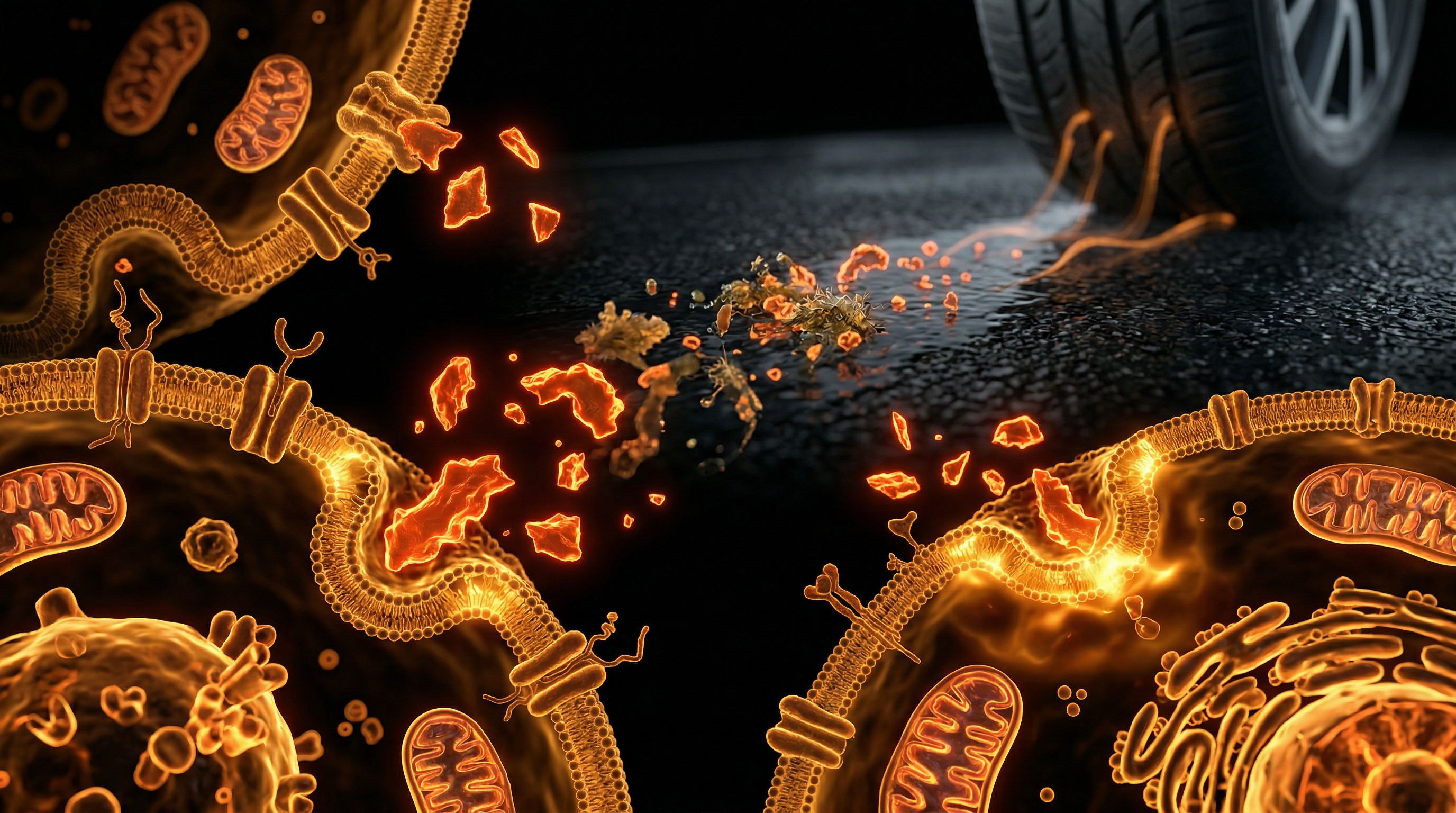
Nanoplastics (NPs) derived from tyre wear are small enough to bypass the standard barriers of the gut and lungs. Through a process called endocytosis, cells actively engulf these particles. Once inside the cytoplasm, the particles are transported to lysosomes. However, the synthetic nature of the polymer means the lysosome cannot break it down, leading to "lysosomal swelling" and eventual rupture, releasing digestive enzymes into the cell itself.
Oxidative Stress and ROS Generation
The presence of heavy metals (Zinc, Cadmium, Lead) and PAHs on the surface of TWPs triggers the production of Reactive Oxygen Species (ROS).
- Lipid Peroxidation: ROS attack the phospholipid bilayers of cell membranes, compromising their integrity.
- Mitochondrial Dysfunction: TWPs have been shown to localise within the mitochondria, the cell's powerhouse. By disrupting the electron transport chain, they reduce ATP (energy) production and trigger apoptosis (programmed cell death).
The Trojan Horse Effect
This is perhaps the most dangerous mechanism. TWPs are highly "sorptive." In the urban road environment, they act like sponges, absorbing other toxins such as heavy metals from brake dust and persistent organic pollutants (POPs) from exhaust fumes. When an organism ingests a TWP, these concentrated toxins are "desorbed" in the acidic environment of the stomach or the lipid-rich environment of the cell, delivering a much higher dose of poison than would be encountered in the ambient environment.
Protein Corona Formation
Upon entering a biological fluid (blood, mucus, or interstitial fluid), a TWP is immediately coated with proteins, forming a "protein corona." This biological "shroud" can trick the immune system into misidentifying the particle, allowing it to move deeper into tissues or even cross the Blood-Brain Barrier (BBB).
Environmental Threats and Biological Disruptors
The UK's topography and infrastructure make it a "perfect storm" for tyre-related ecological collapse. Because our road drainage systems (gullies) often lead directly to local brooks and rivers without sophisticated filtration, every rain event becomes a "toxic pulse."
Aquatic Toxicology: The 6PPD-Quinone Crisis
The discovery of 6PPD-quinone's toxicity was a watershed moment in environmental science. In species like the Coho salmon (and potentially UK species like Atlantic Salmon and Brown Trout), 6PPD-quinone causes a "blood-brain barrier breakdown."
- Symptomatology: Affected fish exhibit "surface gasping," loss of equilibrium, and circular swimming before dying within hours.
- Lethality: The LC50 (lethal concentration for 50% of the population) is incredibly low—measured in micrograms per litre.
Trophic Transfer: The Food Web Contamination
Microplastics from tyres are ingested by primary consumers—zooplankton and benthic invertebrates (shrimp, worms).
- Bioaccumulation: As these small organisms are eaten by larger fish, the concentration of tyre-derived chemicals increases.
- Benthic Loading: TWPs are denser than many other microplastics because of the carbon black and metal content. This causes them to sink and accumulate in the riverbed sediment, poisoning the "nurseries" of our aquatic ecosystems.
Endocrine Disruption
Many of the additives in tyres, such as phthalates and alkylphenols, are known Endocrine Disrupting Chemicals (EDCs). They mimic hormones like oestrogen. In UK rivers, we are observing "intersex" fish—males developing oocytes (egg cells)—a phenomenon strongly linked to the chemical runoff from urban roads.
Statistic: Studies have shown that tyre wear can account for up to 28% of the total primary microplastics reaching the world's oceans, often surpassing plastic pellets (nurdles) and synthetic textile fibres.
The Cascade: From Exposure to Disease
The biological impact of TWPs is not confined to the riverbank. In humans, the "cascade" of exposure leads to chronic, systemic inflammation.
The Respiratory Pathway (PM2.5 and PM0.1)
The UK has strict standards for exhaust emissions, but tyre wear is currently unregulated. TWPs contribute significantly to PM2.5 (particulate matter under 2.5 microns) and, more dangerously, PM0.1 (ultrafine particles).
- Inflammation: Once inhaled, these particles settle in the alveoli (air sacs) of the lungs. The immune system's macrophages attempt to clear them but fail, leading to chronic inflammation, asthma exacerbation, and potentially Lung Carcinoma.
- Systemic Entry: Ultrafine tyre particles can cross the lung-blood barrier, entering the systemic circulation.
Cardiovascular Implications
Once in the bloodstream, TWPs and their leached chemicals (like Zinc and PAHs) contribute to atherosclerosis (hardening of the arteries). The oxidative stress induced by these particles causes endothelial dysfunction—the lining of the blood vessels loses its ability to dilate, leading to hypertension and increased risk of myocardial infarction (heart attack).
The Neurological Connection
Emerging research suggests a link between the inhalation of nano-scale road particles and neurodegenerative diseases such as Alzheimer’s and Parkinson’s. The mechanism involves the Olfactory Bulb Pathway—particles inhaled through the nose can travel directly along the olfactory nerve into the brain, bypassing the blood-brain barrier and triggering "neuroinflammation."
Autoimmune Triggers
The chronic presence of synthetic polymers in the body may act as an "adjuvant," over-stimulating the immune system. This persistent state of high alert can lead the body to lose self-tolerance, potentially triggering or worsening autoimmune conditions like Rheumatoid Arthritis or Lupus.
What the Mainstream Narrative Omits
The "Green Revolution" in transport has a glaring blind spot. The mainstream narrative focuses on "zero emissions at the tailpipe," but it ignores the "Zero Emission" car's contribution to tyre pollution.
The EV Paradox
Electric Vehicles are a vital part of reducing CO2, but they are significantly heavier than Internal Combustion Engine (ICE) vehicles due to their lithium-ion battery packs.
- Increased Mass: A typical EV can be 20% to 30% heavier than its ICE equivalent.
- Instant Torque: EVs deliver high torque to the wheels instantly, which increases friction and shear forces on the tyre.
- The Result: Early data suggests that tyre wear rates for EVs can be 20% to 50% higher than for traditional vehicles. We are trading air pollution (gas) for soil and water pollution (solids).
The "Ozone-6PPD" Loophole
Regulatory bodies like the EPA (USA) and the UK's DEFRA have known about 6PPD for decades. However, because it was considered "bound" within the rubber matrix, it was not strictly regulated as a water pollutant. The industry has been allowed to use 6PPD despite knowing it leaches and transforms into a far more toxic quinone.
Regulatory Lag and Corporate Lobbying
The tyre industry is a multi-billion pound global powerhouse. Standardising "low-wear" tyres is difficult because of the "magic triangle" of tyre design: Grip, Fuel Economy, and Longevity. Improving one usually compromises the others. For years, manufacturers have prioritised grip (safety) and fuel economy (rolling resistance) while ignoring the biological impact of the wear particles themselves.
The "Hidden" Chemicals
While we focus on 6PPD, there are hundreds of other additives—proprietary resins, anti-agers, and accelerators—whose safety profiles have never been tested in a "runoff" context. The industry operates under a "guilty until proven innocent" framework regarding chemical toxicity, which often takes decades of ecological damage to prove.
The UK Context
The United Kingdom presents a unique set of challenges regarding tyre wear. Our geography, climate, and infrastructure make us particularly susceptible to the "road runoff" crisis.
The Rainfall Factor
Unlike drier climates where tyre dust might sit on the road for months, the UK experiences frequent, heavy rainfall. This ensures that TWPs are constantly washed into the drainage system. This "chronic pulsing" of toxins prevents aquatic ecosystems from ever reaching a state of recovery.
The Victorian Sewage Problem
In many UK cities, road drainage is connected to "Combined Sewer Overflows" (CSOs). During heavy rain, these systems become overwhelmed, discharging a mixture of raw sewage and toxic road runoff directly into rivers. This creates a "synergistic toxicity"—the organic matter in sewage can actually change the bioavailability of tyre chemicals, making them more easily absorbed by fish.
High-Density Road Networks
The UK has one of the highest densities of road networks in Europe. The M25, the M6, and the "Smart Motorway" schemes create vast corridors of tyre emissions. A study of the River Thames found that microplastics—including tyre fragments—were present in the guts of nearly 30% of all fish sampled.
The UK Regulatory Stance
Following Brexit, the UK has the opportunity to lead in "UK REACH" (Registration, Evaluation, Authorisation and Restriction of Chemicals). However, there is significant pressure to maintain "regulatory alignment" with the EU, which has been slow to mandate specific tyre composition changes. The UK's Air Quality Expert Group (AQEG) has formally recognised that non-exhaust emissions (NEE) will constitute the majority of primary particulate matter from road transport by 2025.
Protective Measures and Recovery Protocols
Given the ubiquity of tyres, we cannot simply "ban" the problem. We require a multi-level strategy involving infrastructure, biological remediation, and personal health protocols.
Infrastructure: Nature-Based Solutions
The UK must transition toward Sustainable Drainage Systems (SuDS).
- Rain Gardens and Bioswales: By directing road runoff into engineered plant beds, the soil and roots act as natural filters. Mycorrhizal fungi and bacteria in the soil can break down certain PAHs and capture heavy metals before they reach the water table.
- Gully Pot Filters: New technologies, such as those developed by UK startups like The Tyre Collective, involve fitting devices directly behind the wheels to capture particles at the source using electrostatics.
Policy Shifts: The "Tyre Euro 7" Standard
Future vehicle standards must include "Abrasion Limits." Tyres should be rated not just for fuel efficiency and noise, but for their "particulate shed rate." This would force manufacturers to move away from toxic antioxidants like 6PPD and find safer bio-alternatives.
Biological Recovery: Supporting the Body’s Detoxification
From a biological perspective, individuals living in high-traffic areas (e.g., London, Manchester, Birmingham) must focus on mitigating the "Oxidative Stress" caused by TWP inhalation.
- Nrf2 Activation: Compounds like Sulforaphane (found in broccoli sprouts) activate the Nrf2 pathway, which enhances the body's production of endogenous antioxidants like Glutathione, helping to neutralise ROS from tyre particles.
- Chelation Therapy Support: Natural binders such as Modified Citrus Pectin or Chlorella may assist in the removal of heavy metals leached from road dust.
- Air Filtration: Using HEPA and activated carbon filters in homes near major A-roads is no longer a luxury—it is a biological necessity to remove the PM0.1 tyre fraction.
Environmental Remediation
"Phytoremediation" using specific aquatic plants like Phragmites australis (Common Reed) in constructed wetlands can help sequester tyre-derived metals and breakdown complex organic pollutants from runoff before they enter major river systems.
Summary: Key Takeaways
The reality of tyre wear emissions is a stark reminder that "sustainable" technology is often anything but, if we look only at a single metric like CO2.
- The Scale of the Problem: Tyre wear is a primary source of microplastic pollution in the UK, often exceeding tailpipe emissions in total mass of particulate matter.
- The Toxic Gun: 6PPD-quinone is a highly lethal byproduct of tyre antioxidants that is currently decimating aquatic life and threatening the stability of UK river ecosystems.
- The Cellular Siege: TWPs trigger oxidative stress, mitochondrial damage, and systemic inflammation in both humans and animals. They are "Trojan Horses" for other urban toxins.
- The EV Reality: The shift to heavier electric vehicles will increase tyre wear rates, making this an escalating crisis rather than a receding one.
- The Need for Action: To protect the UK's biological future, we must implement mandatory tyre abrasion standards, redesign our urban drainage to include filtration (SuDS), and move beyond the "zero-exhaust" myth.
The asphalt under our wheels is shedding a chemical legacy that will persist in our sediments and our cells for generations. Only by exposing this "hidden runoff" can we begin the work of biological and environmental recovery. The time for the UK to regulate the "contact patch" is now, before our rivers become nothing more than liquid corridors of synthetic waste.
This article is provided for informational and educational purposes only. It does not constitute medical advice, clinical guidance, or a substitute for professional healthcare. Information reflects cited research at time of publication. Always consult a qualified healthcare professional before acting on any health information.
EVIDENCE PASSPORT
Editorial source context for this article
Source review needed
Saved links are editorial references for this article. They may support specific claims rather than every sentence. Open and assess each source in context. This passport does not independently verify them.
Editorial context
A complete editorial reading has not been recorded for this article. Source links remain available for you to open and assess directly.
Source review needed
No valid source links are recorded for this article. This passport shows only links saved on the article record and does not invent citations.
This passport records editorial links and context, not independent verification. Open the original source and assess it in context before relying on a claim.
Medical Disclaimer
The information in this article is for educational purposes only and does not constitute medical advice, diagnosis, or treatment. Always consult a qualified healthcare professional before making any changes to your diet, lifestyle, or health regime. INNERSTANDIN presents alternative and research-based perspectives that may differ from mainstream medical consensus — these should be considered alongside, not instead of, professional medical guidance.
Read Full DisclaimerContinue the thread
Keep this question moving.
Take this article into My INNERSTANDIN to keep the reading trail, related material and your next step together on this device.
Dig deeper in the Library
Free, longform PDF volumes that go beyond headlines into mechanisms and references.