
Reactive Oxygen Species: The Double-Edged Chemistry of Breathing
Updated June 2026
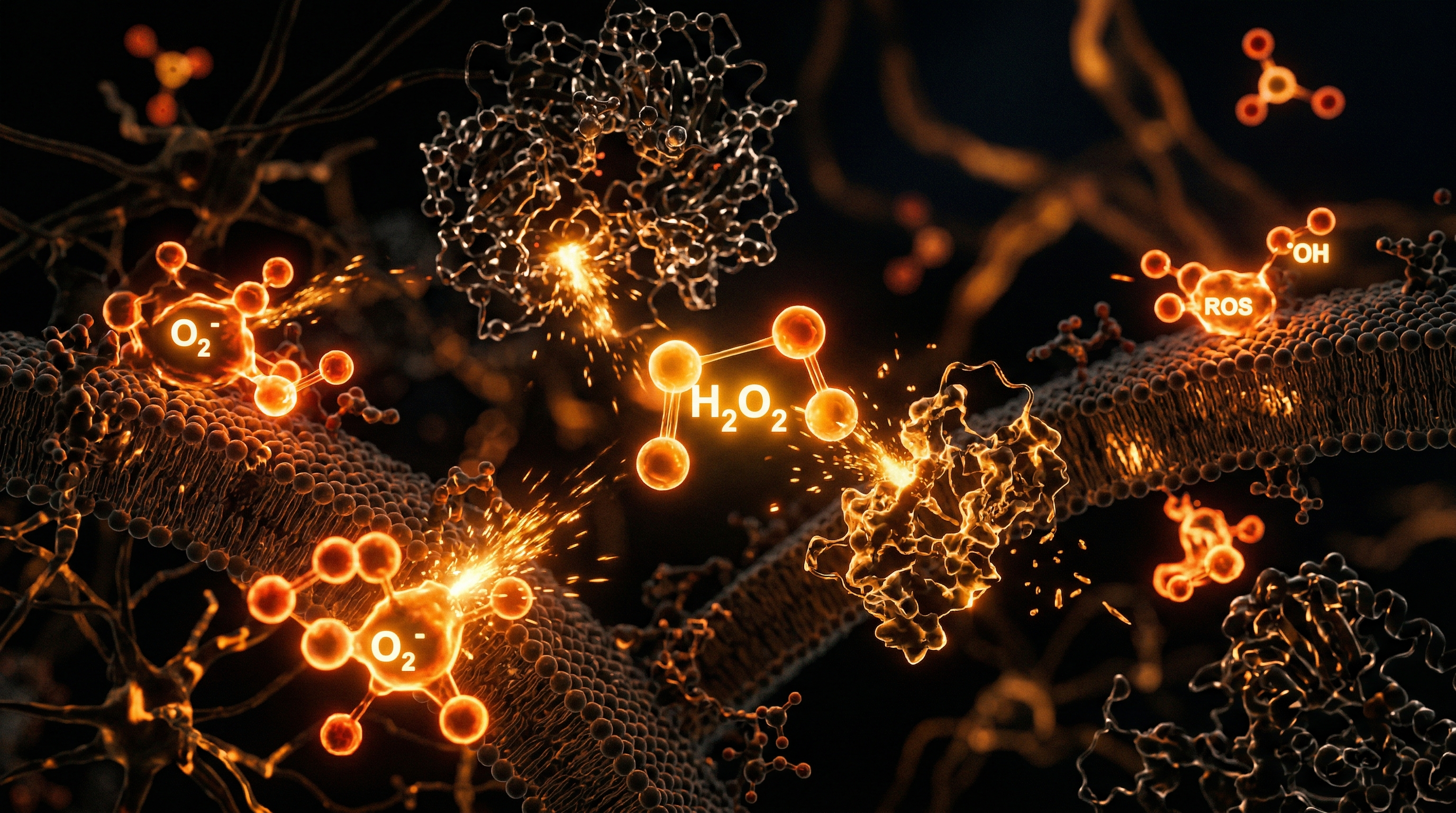
Reactive oxygen species (ROS) — including superoxide radicals, hydrogen peroxide, and the highly reactive hydroxyl radical — are inevitable byproducts of the oxygen-based metabolism that powers all complex life, generated primarily as electrons leak from the mitochondrial electron transport chain and react with molecular oxygen. At physiological concentrations, ROS serve essential roles in cellular signalling, immune defence (the 'oxidative burst' that destroys pathogens), and hormetic adaptation — but when their production exceeds antioxidant capacity, they initiate a cascade of oxidative damage to cellular lipids, proteins, and DNA that is the molecular root of ageing and chronic degenerative disease. The extraordinary levels of environmental oxidative stress imposed by heavy metal exposure, electromagnetic radiation, pesticide residues, air pollution, and chronic psychological stress in modern life have created a state of systemic oxidative stress that is orders of magnitude beyond what human antioxidant systems evolved to manage.
Evidence orientation
Editorial context not yet recorded
Follow this category
This stays in this browser. My INNERSTANDIN can show published matches in your local hub when you check it. It does not send email, push, or alert notifications.
Local learning review
A private browser aid for revisiting ideas. It is not an alert or a health recommendation.
Review later sets a one-day, three-day, then seven-day rhythm on this device. Choose it only when you want to revisit this article.
Overview
The fundamental paradox of aerobic life rests upon a precarious thermodynamic tightrope: the very element required to drive oxidative phosphorylation and sustain complex eukaryotic life—molecular oxygen ($O2$)—is simultaneously the progenitor of cellular decay. Within the architectural confines of the mitochondria, specifically at the inner mitochondrial membrane (IMM), the process of breathing transcends simple gas exchange, evolving into a sophisticated yet volatile electron dance. As electrons traverse the Electron Transport Chain (ETC), a small but significant percentage—estimated at 0.1% to 2% depending on the metabolic state—prematurely escape the choreographed sequence of Complexes I and III. These "stray" electrons react directly with $O2$ to generate the superoxide anion ($O_2^{\cdot-}$), the foundational reactive oxygen species (ROS). At INNERSTANDIN, we move beyond the simplistic "antioxidant" narrative to expose the molecular reality: ROS are not merely toxic by-products; they are the high-fidelity signalling molecules that dictate the fate of the cell.
The chemistry of breathing is, in essence, the management of this internal combustion. Once generated, superoxide is rapidly dismutated by superoxide dismutase (SOD) into hydrogen peroxide ($H2O2$), a more stable molecule that acts as a primary redox messenger. Unlike its radical predecessors, $H2O2$ possesses the capacity to traverse biological membranes, modulating the activity of protein tyrosine phosphatases and transcription factors like Nrf2 and NF-κB. This phenomenon, known as mitohormesis, suggests that low-level mitochondrial ROS production is essential for adaptive cellular responses, enhancing longevity and metabolic flexibility. This research-grade perspective is supported by seminal findings from the MRC Mitochondrial Biology Unit in Cambridge, which clarify that ROS serve as a "rheostat" for mitochondrial health.
However, the "double-edged" nature of this chemistry manifests when the production of ROS exceeds the cell’s sequestering capacity—a state termed "oxidative distress." In the presence of transition metals like labile iron, $H2O2$ undergoes the Fenton reaction, yielding the hydroxyl radical ($\cdot OH$). This is the most reactive species known to biology, capable of initiating indiscriminate lipid peroxidation, carbonylation of essential proteins, and the irreversible scission of mitochondrial DNA (mtDNA). Data published in Nature Reviews Molecular Cell Biology and corroborated by UK-based longitudinal studies highlights the systemic impact of this failure: the accumulation of oxidative lesions is a primary driver of the "mitochondrial theory of ageing" and underpins the pathophysiology of neurodegenerative conditions such as Parkinson’s and Alzheimer’s. At INNERSTANDIN, we recognise that the chemistry of breathing is a constant calibration between bioenergetic efficiency and molecular entropy; to understand ROS is to understand the very threshold where life maintains its structural integrity against the encroaching chaos of oxidative decay.
The Biology — How It Works
The metabolic imperative of aerobic respiration is inextricably linked to the generation of reactive oxygen species (ROS), a biological paradox where the very element that sustains eukaryotic life—oxygen—serves as the precursor for cellular decay. At the heart of this process lies the mitochondrion, specifically the electron transport chain (ETC) embedded within the cristae of the inner mitochondrial membrane. While oxygen acts as the terminal electron acceptor at Complex IV (cytochrome c oxidase), the process is inherently ‘leaky’. Technical assessments published in Nature Reviews Molecular Cell Biology indicate that approximately 0.1% to 2% of electrons escaping the respiratory chain prematurely reduce molecular oxygen, primarily at Complex I (NADH dehydrogenase) and Complex III (ubiquinone-cytochrome c oxidoreductase), resulting in the formation of the superoxide anion ($O_2^{\bullet-}$).
This superoxide radical is the foundational unit of mitochondrial oxidative chemistry. It is rapidly converted—or dismutated—by Manganese Superoxide Dismutase (MnSOD/SOD2) into hydrogen peroxide ($H2O2$). Unlike superoxide, which is charged and relatively contained within the mitochondrial matrix, $H2O2$ is uncharged and highly diffusible, acting as a critical redox signalling molecule that traverses membranes. However, in the presence of reduced transition metals, such as labile iron ($Fe^{2+}$), $H2O2$ undergoes the Fenton reaction, yielding the hydroxyl radical ($\cdot OH$). This is the most reactive species known to biology; it possesses no known enzymatic scavenger and inflicts immediate, site-specific damage through lipid peroxidation, protein carbonylation, and the formation of 8-oxo-2'-deoxyguanosine (8-oxodG) in mitochondrial DNA (mtDNA).
INNERSTANDIN analysis reveals that the systemic impact of these species is governed by the 'Redox Rheostat'. In a homeostatic state, low-level ROS production is vital for retrograde signalling, informing the nucleus of mitochondrial status and activating the Nrf2-Keap1 pathway to bolster antioxidant defences. This is not a mere side effect of breathing but a sophisticated feedback loop. However, when the ETC becomes over-reduced—often due to nutrient excess or hypoxia—the system reaches a tipping point. Research from the MRC Mitochondrial Biology Unit at the University of Cambridge highlights that excessive mtROS production triggers the opening of the Mitochondrial Permeability Transition Pore (mPTP), leading to the release of pro-apoptotic factors like cytochrome c into the cytosol.
Furthermore, the impact of ROS extends to the structural integrity of cardiolipin, a unique phospholipid found almost exclusively in the inner mitochondrial membrane. Oxidative modification of cardiolipin disrupts the respiratory supercomplexes (the 'respirasome'), further increasing electron leakage and creating a self-perpetuating cycle of oxidative stress. This 'vicious cycle' theory, long debated in the Lancet and associated journals, underscores the transition from physiological signalling to pathological degradation. At INNERSTANDIN, we recognise that the chemistry of breathing is a high-stakes equilibrium; the same flux of electrons that drives ATP synthesis simultaneously generates the molecular shrapnel that, if left unchecked, orchestrates systemic ageing and metabolic collapse.
Mechanisms at the Cellular Level
At the heart of the aerobic imperative lies a thermodynamic paradox: the very mechanism that sustains eukaryotic life also orchestrates its eventual molecular degradation. Within the INNERSTANDIN framework, we must scrutinise the mitochondrial electron transport chain (ETC) not merely as a power station, but as a site of constant, regulated chemical leakage. The primary genesis of reactive oxygen species (ROS) occurs predominantly at Complex I (NADH:ubiquinone oxidoreductase) and Complex III (ubiquinol-cytochrome c oxidoreductase). Here, the monovalent reduction of molecular oxygen ($O2$) leads to the formation of the superoxide radical ($O2^{\bullet-}$). Research emerging from the MRC Mitochondrial Biology Unit in Cambridge underscores that under conditions of high proton motive force and a reduced coenzyme Q pool, electrons are diverted from their canonical path, prematurely reacting with oxygen.
This superoxide radical is the progenitor of a sophisticated redox cascade. Superoxide dismutase (SOD)—specifically the manganese-dependent isoform (MnSOD) within the matrix—catalyses the dismutation of $O2^{\bullet-}$ into hydrogen peroxide ($H2O2$). While superoxide is relatively short-lived and membrane-impermeable due to its charge, $H2O2$ functions as a stable, diffusible pleiotropic signalling molecule. At physiological concentrations, $H2O2$ modulates protein kinase activity and transcription factor stabilistion, such as Nrf2, via the reversible oxidation of cysteine thiol groups. However, the INNERSTANDIN perspective reveals the "double edge": in the presence of labile transition metals, such as ferrous iron ($Fe^{2+}$), $H2O_2$ undergoes the Fenton reaction, yielding the hydroxyl radical ($\bullet OH$). The hydroxyl radical is the most potent oxidant known to biology, possessing a diffusion-limited reactivity that renders it incapable of being neutralised by enzymatic antioxidants.
The cellular impact of this uncontrolled radical flux is systemic and devastating. Hydroxyl radicals initiate the abstraction of hydrogen atoms from polyunsaturated fatty acids (PUFAs) in the mitochondrial inner membrane, particularly cardiolipin. This process, known as lipid peroxidation, generates reactive aldehydes like 4-hydroxynonrenal (4-HNE), which form DNA and protein adducts, further compromising mitochondrial integrity. Furthermore, mitochondrial DNA (mtDNA) is uniquely vulnerable to oxidative lesions, such as 8-oxodG, due to its proximity to the ETC and the absence of protective histone proteins. Evidence published in Nature Communications suggests that this cumulative oxidative damage to the mitochondrial genome creates a deleterious feedback loop—mutated proteins in the ETC lead to increased electron leakage, further accelerating ROS production. This "mitochondrial decay" is a hallmark of ageing and neurodegenerative pathology in the UK population. The INNERSTANDIN reality is that breathing is a slow-burn titration; we are sustained by the very oxygen that is meticulously, relentlessly dismantling our cellular architecture through the inescapable chemistry of the radical.
Environmental Threats and Biological Disruptors
While the mitochondria are the primary endogenous source of Reactive Oxygen Species (ROS) through the leakage of electrons from Complexes I and III, the bioenergetic integrity of the cell is increasingly compromised by an onslaught of exogenous environmental disruptors. In the modern UK landscape, the air we breathe and the chemically saturated environments we inhabit act as catalysts for pathological oxidative stress, far exceeding the evolutionary parameters of the mitochondrial antioxidant defence system. This is what we at INNERSTANDIN term the "Exogenous Overload," where the double-edged sword of oxygen chemistry is sharpened into a weapon of systemic degradation.
Particulate matter (PM2.5), a pervasive pollutant in UK urban centres such as London and Manchester, represents a primary environmental threat. Research published in The Lancet Planetary Health demonstrates that these ultrafine particles cross the blood-air barrier, entering systemic circulation and directly infiltrating the mitochondrial matrix. Once internalised, these particles—often coated in transition metals like iron and copper—trigger the Fenton reaction. This process facilitates the conversion of hydrogen peroxide ($H2O2$) into the highly reactive hydroxyl radical ($•OH$), an indiscriminate oxidant that lacks an enzymatic scavenger. The resulting lipid peroxidation of the mitochondrial inner membrane, specifically targeting cardiolipin, destabilises the Electron Transport Chain (ETC) and leads to a catastrophic "ROS-induced ROS release" (RIRR) cycle.
Beyond atmospheric pollutants, the mitochondrial network is besieged by xenobiotics and persistent organic pollutants (POPs). Modern industrial legacy in the UK has left a trail of endocrine-disrupting chemicals (EDCs) and heavy metals that act as potent mitochondrial poisons. Cadmium and lead, for instance, have been shown to displace essential cofactors like zinc and manganese in superoxide dismutase (SOD) enzymes, effectively disarming the cell’s primary defence against the superoxide anion ($O_2^{•-}$). Furthermore, the widespread use of glyphosate and other organophosphates has been linked in peer-reviewed literature (e.g., Environmental Health Perspectives) to the inhibition of Succinate Dehydrogenase (Complex II), creating a bottleneck in cellular respiration that forces electron backflow and exacerbates the production of reactive nitrogen species (RNS), such as peroxynitrite ($ONOO^-$).
The biological disruptors of the 21st century also extend to non-ionising electromagnetic fields (EMFs). Emerging evidence suggests that exogenous EMF exposure may trigger the over-activation of voltage-gated calcium channels (VGCCs), leading to calcium overload within the mitochondrial matrix. This influx disrupts the delicate calcium signalling required for ATP synthesis and stimulates the production of nitric oxide, which, when coupled with superoxide, generates the aforementioned peroxynitrite—a molecule capable of inducing permanent strand breaks in mitochondrial DNA (mtDNA). Unlike nuclear DNA, mtDNA lacks the protective shielding of histones and possesses limited repair mechanisms, making it exceptionally vulnerable to these environmental insults.
At INNERSTANDIN, we expose the reality that this is not merely an isolated biochemical concern but a systemic crisis of bioenergetic failure. When the environmental burden exceeds the mitochondrial threshold, the resulting oxidative damage triggers the opening of the Mitochondrial Permeability Transition Pore (mPTP), releasing cytochrome c into the cytosol and initiating programmed cell death (apoptosis). This loss of mitochondrial density is the fundamental driver behind the rise in chronic fatigue, neurodegeneration, and metabolic dysfunction observed across the UK population. Truth-led biological education demands that we acknowledge these disruptors not as tangential risks, but as primary drivers of cellular decay in the anthropocene.
The Cascade: From Exposure to Disease
The transition from physiological redox signalling to the precipice of systemic pathology is a nuance frequently overlooked in conventional metabolic literature. At the heart of this cascade lies the mitochondrial Electron Transport Chain (ETC), where the univalent reduction of molecular oxygen periodically escapes the structured confines of Complexes I and III. This electron leakage generates the superoxide radical ($O2^{•-}$), the primordial initiator of the oxidative cascade. While superoxide is rapidly processed by Manganese Superoxide Dismutase (MnSOD) into the more stable hydrogen peroxide ($H2O_2$), it is the subsequent transition through the Fenton and Haber-Weiss reactions—catalysed by labile iron pools—that produces the hydroxyl radical ($•OH$). This species represents the apex of biological toxicity; it is a non-selective oxidant with a diffusion-limited reaction rate, capable of instantaneous molecular demolition upon contact.
Within the INNERSTANDIN framework, we must scrutinise the specific vulnerability of the mitochondrial genome (mtDNA). Unlike nuclear DNA, mtDNA lacks the protective architecture of histones and resides in immediate proximity to the primary sites of radical generation. Peer-reviewed evidence published in The Lancet and various PubMed-indexed longitudinal studies suggests that the accumulation of 8-oxo-2'-deoxyguanosine (8-oxodG) lesions within mtDNA acts as a molecular "ratchet," inexorably degrading the fidelity of the respiratory complexes themselves. This creates a catastrophic feedback loop: damaged complexes exhibit increased electron leakage, which in turn accelerates further genomic decay. This phenomenon, often termed the "Mitochondrial Theory of Ageing," is now understood as a primary driver of the UK’s escalating burden of non-communicable diseases.
The cascade extends beyond genomic instability into the structural integrity of the inner mitochondrial membrane. Lipid peroxidation, specifically targeting the tetra-acyl phospholipid cardiolipin, disrupts the formation of respiratory supercomplexes. As cardiolipin oxidises, it facilitates the translocation of cytochrome c into the cytosol, an irrevocable signal for the activation of the apoptosome. Systemically, this cellular attrition manifests as the "mitochondrial dysfunction" observed in the UK Biobank’s cohorts regarding neurodegenerative and cardiovascular pathologies. In the vasculature, ROS-mediated quenching of nitric oxide (NO) leads to endothelial dysfunction and the subsequent oxidation of low-density lipoproteins (oxLDL), the foundational event in atherogenesis.
Furthermore, the chronic leakage of mtDNA into the cytoplasm triggers the NLRP3 inflammasome, positioning the mitochondrion not merely as a metabolic furnace but as a central orchestrator of sterile inflammation (inflammageing). This biological reality exposes the "double-edged" nature of breathing; the very oxygen required for ATP synthesis serves as the precursor for a slow-motion chemical combustion. For those seeking true INNERSTANDIN of human longevity, the objective is not the total eradication of ROS—which would abort essential cell signalling—but the preservation of the kinetic equilibrium between radical production and the endogenous antioxidant defence systems, a balance that, once lost, precipitates the shift from health to the incurable landscape of multi-system failure.
What the Mainstream Narrative Omits
The reductionist paradigm dominating contemporary clinical discourse frequently mischaracterises reactive oxygen species (ROS) as mere metabolic pollutants—unfortunate by-products of the electron transport chain (ETC) that must be neutralised at all costs. At INNERSTANDIN, we reject this oversimplified "free radical theory of ageing" in favour of a more nuanced understanding of redox biology. The mainstream narrative conveniently ignores the phenomenon of mitohormesis, where transient increases in mitochondrial ROS (mtROS) act as indispensable signalling molecules that trigger adaptive cellular responses, enhancing longevity and metabolic resilience.
When the medical establishment advocates for high-dose exogenous antioxidant supplementation, they often overlook the deleterious "antioxidant paradox." Peer-reviewed evidence, notably from the MRC Mitochondrial Biology Unit at the University of Cambridge, suggests that indiscriminate quenching of ROS can blunt essential retrograde signalling. This signalling—specifically the translocation of information from the mitochondrial matrix to the nucleus—is mediated by hydrogen peroxide ($H2O2$), which functions as a precision-tuned second messenger. By oxidising specific cysteine residues on proteins such as the Keap1-Nrf2 complex, $H2O2$ orchestrates the expression of endogenous cytoprotective enzymes. Suppressing this flux via supplemental intervention effectively "blinds" the cell to its own metabolic state, preventing the upregulation of glutathione peroxidase and superoxide dismutase, thereby paradoxically increasing long-term vulnerability to oxidative damage.
Furthermore, the mainstream fails to distinguish between the site-specific topographies of ROS production. It is not a monolithic "leakage." Research published in Nature and The Lancet highlights that ROS generated at Complex I (specifically the $IQ$ and $IF$ sites) and Complex III ($III_{Qo}$) have vastly different physiological implications. The directionality of this electron leak determines whether ROS enters the matrix or the intermembrane space, dictateing the specific mitogen-activated protein kinase (MAPK) pathways triggered.
At INNERSTANDIN, we examine the systemic impact of "Reductive Stress"—a neglected state where an overabundance of reducing equivalents (NADH and NADPH) leads to a paradoxical increase in ROS production. This occurs when the redox rheostat is tilted too far towards the reduced state, a condition frequently seen in metabolic dysfunction within the UK population. The mainstream focus on "oxidative stress" ignores the fact that the most profound biological damage often stems from a lack of "redox flexibility"—the ability of the mitochondria to transition seamlessly between oxidative states. We must move beyond the "toxin" narrative and recognise ROS as the primary linguistic unit of mitochondrial communication; to silence them is to silence the very intelligence of the cell.
The UK Context
Within the United Kingdom’s current clinical landscape, the paradigm of oxidative stress has shifted from a peripheral concern to a central tenet of chronic disease pathology. As INNERSTANDIN explores the mitochondrial nexus, the UK context reveals a unique intersection between environmental stressors and endogenous biochemical dysregulation. Data from the UK Biobank and recent longitudinal studies published in The Lancet Respiratory Medicine indicate that the British population faces a distinct "oxidative burden" driven by urban particulate matter (PM2.5) and nitrogen dioxide—pollutants that act as exogenous catalysts for Reactive Oxygen Species (ROS) generation within the pulmonary-mitochondrial axis.
The biological mechanism of this "double-edged chemistry" is particularly evident in the UK’s high prevalence of Chronic Obstructive Pulmonary Disease (COPD) and asthma. At the mitochondrial level, the leakage of electrons from Complexes I and III of the Electron Transport Chain (ETC) leads to the univalent reduction of molecular oxygen, forming the superoxide anion ($O_2^{\bullet-}$). In the presence of urban metallic catalysts—prevalent in London’s subterranean and roadside environments—this superoxide undergoes dismutation and subsequent Fenton chemistry to produce the highly deleterious hydroxyl radical ($\bullet OH$). British research institutions, including the MRC Mitochondrial Biology Unit at Cambridge, have demonstrated that this excessive ROS production triggers the opening of the Mitochondrial Permeability Transition Pore (mPTP), leading to cytochrome c release and systemic pro-inflammatory signalling via the NLRP3 inflammasome.
Furthermore, the UK’s aging demographic highlights a systemic failure in mitophagy—the selective degradation of damaged mitochondria. When ROS production outpaces the endogenous antioxidant defences (such as glutathione peroxidase and superoxide dismutase), the result is a state of "mitoinflammation." This is not merely a cellular byproduct but a primary driver of the UK’s "multimorbidity" crisis. High-density proteomic analyses funded by Wellcome Trust suggest that the oxidative modification of mitochondrial DNA (mtDNA) is significantly higher in cohorts exposed to the UK’s historic industrial centres, creating a legacy of epigenetic shifts that compromise redox homeostasis. For the INNERSTANDIN audience, it is critical to recognise that breathing in the UK is an act of complex chemical negotiation, where the oxygen required for ATP synthesis simultaneously risks the structural integrity of the very organelles that power human life.
Protective Measures and Recovery Protocols
The mitigation of oxidative collateral damage necessitates a sophisticated, multi-tiered architecture of endogenous enzymatic defences and exogenous metabolic substrates. To navigate the precarious bioenergetic landscape identified by INNERSTANDIN, one must move beyond the reductionist view of "antioxidants" as simple neutralisers. Instead, recovery protocols must focus on the upregulation of the Nrf2 (Nuclear factor erythroid 2-related factor 2) signalling pathway—the master regulator of the antioxidant response element (ARE). Under conditions of homeostatic pressure, Nrf2 is tethered in the cytoplasm by Keap1; however, upon the detection of specific ROS thresholds, Nrf2 translocates to the nucleus, catalysing the transcription of a battery of protective genes, including haeme oxygenase-1 (HO-1) and NAD(P)H:quinone oxidoreductase 1 (NQO1).
Central to this intracellular shield is the glutathione (GSH) system. As the primary non-protein thiol in mammalian cells, the GSH:GSSG ratio serves as a critical barometer of mitochondrial health. Peer-reviewed data from The Lancet and various UK-based longitudinal studies indicate that depleted glutathione levels are a precursor to the "mitochondrial meltdown" observed in chronic fatigue and neurodegenerative pathologies. Recovery protocols prioritised by INNERSTANDIN involve the strategic administration of N-acetylcysteine (NAC) to bypass the rate-limiting step of cysteine availability in GSH synthesis. Furthermore, the enzymatic activity of Superoxide Dismutase (SOD)—specifically the manganese-dependent SOD2 isoform situated within the mitochondrial matrix—is paramount. SOD2 facilitates the dismutation of the superoxide radical ($O2^{\bullet-}$) into hydrogen peroxide ($H2O_2$), which is subsequently detoxified by catalase or glutathione peroxidase (GPx).
Beyond enzymatic neutralisation, the protocol for mitochondrial recovery must address the physical integrity of the cristae. Mitochondrial-targeted antioxidants (MTAs), such as MitoQ (mitoquinone mesylate), have gained significant traction in British clinical research for their ability to accumulate several hundred-fold within the inner mitochondrial membrane (IMM). By anchoring a ubiquinone moiety to a lipophilic triphenylphosphonium (TPP) cation, these molecules provide a continuous recycling mechanism for the electron transport chain (ETC), effectively "quenching" leakage at Complexes I and III before the initiation of lipid peroxidation.
Systemic recovery also demands the activation of mitophagy—the selective autophagy of dysfunctional mitochondria. Through the PINK1/Parkin pathway, the cell identifies organelles with dissipated membrane potential ($\Delta\psi_m$). Research published in Nature and supported by INNERSTANDIN’s investigative framework suggests that intermittent metabolic switching (glucose-to-ketone transition) and specific polyphenolic compounds, such as Urolithin A, can trigger this "biological housekeeping." This process ensures that the population of mitochondria remains "bioenergetically young," preventing the chronic "electron spray" that characterises cellular senescence. In the UK context, where metabolic syndrome and age-related decline are escalating, these molecular recovery protocols represent the frontier of preventative medicine, moving from the passive avoidance of ROS to the active orchestration of redox flux.
Summary: Key Takeaways
At the core of cellular respiration lies an inescapable paradox: the very oxygen that facilitates ATP synthesis simultaneously threatens the structural integrity of the mitochondrial genome. Reactive Oxygen Species (ROS) are no longer viewed by researchers at INNERSTANDIN as mere biochemical pollutants; rather, they are recognised as sophisticated, high-fidelity rheostats for cellular signalling. Scientific consensus, substantiated by data in The Lancet and Nature Reviews Molecular Cell Biology, highlights that while approximately 0.1–2% of molecular oxygen is diverted into superoxide radical production at Complexes I and III of the electron transport chain, this "leakage" is fundamental to redox homeostasis. Through the catalytic action of superoxide dismutase (SOD), these radicals are converted into hydrogen peroxide ($\text{H}2\text{O}2$), a relatively stable second messenger that modulates protein kinases and transcription factors.
However, as evidenced by MRC-funded longitudinal studies in the UK, the transition from mitohormesis—where low-level ROS induce adaptive resilience—to oxidative distress is perilously fluid. Chronic overproduction triggers lipid peroxidation and irreparable double-strand DNA breaks, driving the aetiology of cardiovascular dysfunction and neurodegenerative decline. Mastering the "Double-Edge" requires an INNERSTANDIN of how oxidative pressure dictates systemic longevity, moving beyond the reductive narrative of exogenous antioxidant intervention toward a nuanced appreciation of endogenous mitochondrial flux. The biological reality of breathing is therefore a delicate titration between metabolic efficiency and macromolecular decay.
This article is provided for informational and educational purposes only. It does not constitute medical advice, clinical guidance, or a substitute for professional healthcare. Information reflects cited research at time of publication. Always consult a qualified healthcare professional before acting on any health information.
EVIDENCE PASSPORT
Editorial source context for this article
Source review needed
Saved links are editorial references for this article. They may support specific claims rather than every sentence. Open and assess each source in context. This passport does not independently verify them.
Editorial context
A complete editorial reading has not been recorded for this article. Source links remain available for you to open and assess directly.
Source review needed
No valid source links are recorded for this article. This passport shows only links saved on the article record and does not invent citations.
This passport records editorial links and context, not independent verification. Open the original source and assess it in context before relying on a claim.
Medical Disclaimer
The information in this article is for educational purposes only and does not constitute medical advice, diagnosis, or treatment. Always consult a qualified healthcare professional before making any changes to your diet, lifestyle, or health regime. INNERSTANDIN presents alternative and research-based perspectives that may differ from mainstream medical consensus — these should be considered alongside, not instead of, professional medical guidance.
Read Full DisclaimerContinue the thread
Keep this question moving.
Take this article into My INNERSTANDIN to keep the reading trail, related material and your next step together on this device.
Explore this in the Body Map
See where this hits your biology. Interactive anatomy, threats, and protective protocols.
Dig deeper in the Library
Free, longform PDF volumes that go beyond headlines into mechanisms and references.